How to run a marathon without losing muscle
As a strength athlete, I used to avoid running long distances. We think that running more than thirty minutes will make us look very skinny, but it's not really the case if you train right. I had the chance to run a marathon for the first time, I got leaner, stronger and increased my endurance. I want to share my experience. In this article we will give you tips to help you run a marathon without losing any muscle.
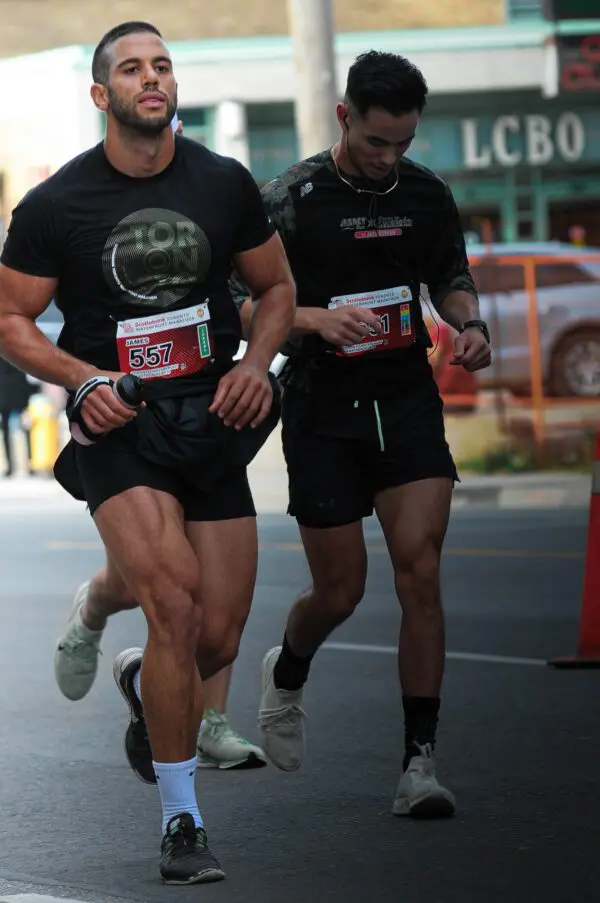
This article doesn't aim to give you the perfect workout schedule to help you train for a marathon. I will simply share my experience so you can get some valuable takeaways.
I didn't want to change my current workout routine too much so I decided to add two weekly runs to my schedule:
- 1 long distance, slow pace run (up to 36 km - 22.5 miles): this run would increase on a weekly basis. The goal is to simply get the body and the mind to be used to long distances. I'm not trying to be crazy fast here. I run at a pace I know can maintain for hours. I never really ran 42 km (26 miles) until race day. So the furthest I tried was 36 km (22 miles). Here's the evolution of this run over time:
- Week 1: 7 km (4 miles)
- Week 2: 9 km (5.6 miles)
- Week 3: 11 km (7 miles)
- ...
- Week 10: 36 km (22.5 miles)
- ...
- Last run before race (taper): 21 km (13 miles)
- 1 short distance, fast pace run (up to 10 km - 6 miles): this run would allow me to increase my speed. It also trains your body to get rid of acid lactic faster. Then I would run the long distance one with more ease.
I started three months prior to my race. My goal was simply to finish the marathon so running two times a week worked really well.
I train six times a week and I play soccer up to three times a week so I needed to make my schedule work with the additional marathon training.
My workout routine:
- Sunday:
- Morning: Chest and Back (heavy)
- Monday:
- Morning: Shoulders and arms (moderate / light weight)
- Evening: Long distance run
- Tuesday:
- Morning: Legs and mobility (light weight)
- Evening: Soccer
- Wednesday:
- Morning: Chest and back (moderate / light weight)
- Evening: Short distance run
- Thursday:
- Morning: Shoulders and arms (heavy)
- Friday:
- Morning: Legs (heavy / moderate)
- Evening: Soccer
- Saturday:
- Morning: Soccer
As you can see I'm active every day, but some workouts are less intense than others so I used them as active recovery. Our schedules and lifestyles are different, so make sure you find what works best for you.
Here's a training plan you should try:
When you run, your body will use glycogen as primary source of energy. Glycogen is glucose being stored in your liver and your muscles. Once you run out of glycogen, your body will use fat as energy. However, if the aerobic activity becomes too long your body may break down muscle to get some energy, which is not what we want. Therefore, our goal will be to adjust our nutrition before and during the race, so the body has enough energy to keep our muscles intact.
Our body roughly has 500 g of glycogen, which is 2000 calories (1g of glucose = 4 calories). So if you burn more than 2000 calories during your race, you will burn some fat then eventually break down some muscle.
During my race I burned 3330 calories (which depends on your weight, age...). So here's how much calories I needed: 3330 calories (burned during the race) - 2000 calories (estimate of glycogen stored in the body) = 1300 calories (rough amount calories needed for my body to be able to perform without breaking down my muscle).
Studies suggest that you consume around 30 to 60 grams of carbohydrates per hour. In my case, I finished the marathon in 4 hours, which would mean: 60 grams * 4 hours = 240 grams -> 960 calories (240 * 4). So based on our numbers, you should aim to consume between 960 calories to 1300 calories to perform well and keep your muscle mass.
Keep in mind that we're all different, so these numbers would be adjusted slightly based on your body composition, gender, age etc.
There's no perfect food for your race. It all depends on what feels better for you. Some people would be able to eat fruits while running while others would prefer gels or drinks.
I chose to make my own energy drink, which would include electrolytes and maltodextrin, which is an easily digestible type of glucose. I had my water bottle which contained 120g of maltodextrin with some electrolytes, which lasted me two hours. Then I had four gels for the rest of the race.
Here's a list of carbohydrate sources:
- 1 banana: 27g -> 108 calories
- 1 scoop of maltodextrin: 50g -> 200 calories
- 1 gel: 27g -> 108 calories
- 1 date: 20g -> 80 calories
- 1 energy bar: 25g -> 100 calories
It's highly recommended to eat at least 3 hours before the marathon. A moderate carbohydrate, low fibers, low fat, low protein meal would be ideal. Fat, protein and fibers take longer to be digested. I personally had some fruits around (80-100 g of carbs), but it is something you can master when you're training for the race.
You will be sweating a lot during the race, so it's recommended to drink up to 200 ml every 15 minutes. You can adjust based on how you feel. Before my run I tend to drink a lot, so I have plenty of fluids. However, it can be a downside if you drink right before the race, it can make you want to go to the washroom a lot. So try to stop drinking at least 1 hour before the race, it worked well for me.
Congrats! Drink plenty of fluids, but avoid going crazy on the food right away it will make you get an upset stomach.
- Stick to your pace and to your plan.
- Don't change your shoes before the race.
- Don't change your nutrition last minute.
- If you want to go to the washroom, do it right away.
- Use the aids station, they will remind you to stay hydrated.