Strength Training Terminology
If you work out regularly, you will get comfortable with the strength training terminology.
They will help you understand how to structure and improve your training routine.
In this article we will explain hypertrophy, progressive overload, etc.
Here are 4 important principles of strength training:

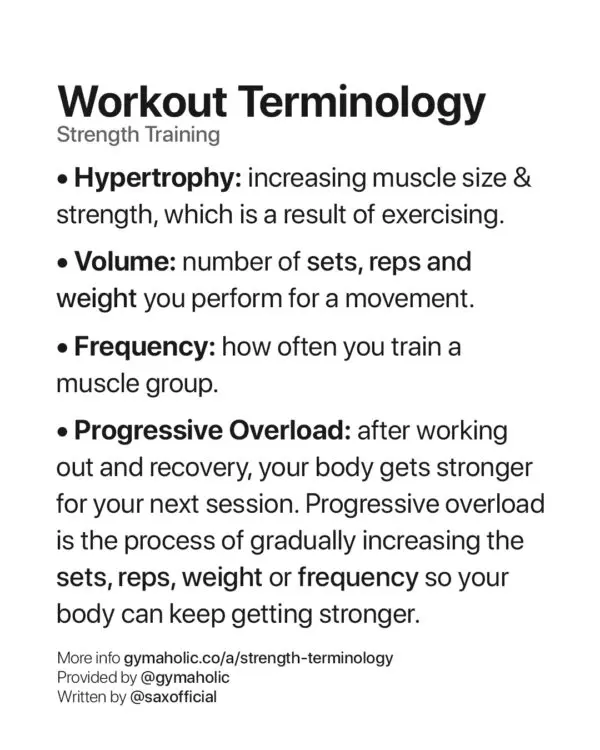
It is the goal of increasing muscle size & strength, which is a result of exercising.
Which is the same as saying "I want to build muscle."
Hypertrophy is the process of building muscle mass with strength training.
It's the amount of work you do in your training session.
Training volume is the number of reps, sets and weight you do in a workout.
It is how often you train a muscle group.
The more you train it, with at least 48 hours of recovery between sessions, the more results you will get.
Training frequency is how often you train a particular muscle group. It's recommended to train a muscle group 2-3 times a week, with proper recovery.
Here's a workout you should try:
After exercising and proper recovery, your body gets stronger for the next session.
So you need to increase training volume if you want to keep progressing.
Progressive overload is the process of gradually increasing the reps, sets, weight or frequency so your body can keep getting stronger.
As you get more consistent in your fitness journey, you will notice how important these factors are.
When your first start exercising, your number of reps / sets / weight keeps increasing.
Then you will hit a plateau, and that's when it becomes interesting.
When this occurs, the goal is not to try to "force" the progressive overload by adding more weight and diminishing the importance of proper form.
You will have to plan how to overcome this plateau, as a strategist and an athlete.
That's a skill-set that will be necessary throughout your fitness journey.
Personally, I like changing one variable at a time.
For example, increase the weight, then see how far I can do that.
If I cannot overcome this plateau after 2-3 times, I first look at my fatigue.
Stress and tiredness have a big impact on your performance.
If these are good, I tend to increase hypertrophy by adding another training session.
However, not everyone can train a muscle group two times a week.
So my recommendation to you is, adjust one variable at a time, stay consistent and track your progress.
Strength training is a very interesting activity if you practice it seriously.
It will help you build problem solving skills, resilience and patience, which we all need more of.
Frequently Asked Questions
Hypertrophy refers to the process of increasing muscle size and strength through exercise. It involves targeted workouts that stimulate muscle fibers, leading to growth over time. To effectively achieve hypertrophy, focus on progressive overload and adequate recovery.
Training volume, which includes the number of sets, reps, and weight lifted, directly impacts muscle growth. Higher training volume can lead to greater muscle hypertrophy, but it's important to balance it with adequate rest and recovery to avoid overtraining.
For optimal results, it's recommended to train each muscle group 2-3 times per week. This frequency allows for sufficient stimulus and recovery, promoting muscle growth and strength gains. Ensure at least 48 hours of rest between sessions for the same muscle group.
Progressive overload is the gradual increase in exercise intensity, such as adding more weight or reps, to continue challenging your muscles. It's crucial for continuous improvement in strength and muscle growth. Without progressive overload, your body may reach a plateau.
To overcome a plateau, consider adjusting one training variable at a time, such as increasing weight or adding another session. Assess factors like fatigue and stress, as they can impact performance. For more strategies, check out How To Overcome A Fitness Plateau? Switch Things Up.
The Gymaholic App offers features like workout tracking, customizable plans, and progress monitoring, which can help you stay consistent and make informed adjustments to your training. Explore more about the app's capabilities on the Gymaholic App.