How to Achieve Your New Year’s Health and Fitness Goals
2020 had a big impact on the way we eat and the way we train.
It gave us a couple lessons that we need to learn from.
Here are 4 effective tips to help you achieve your 2021 health and fitness goals:
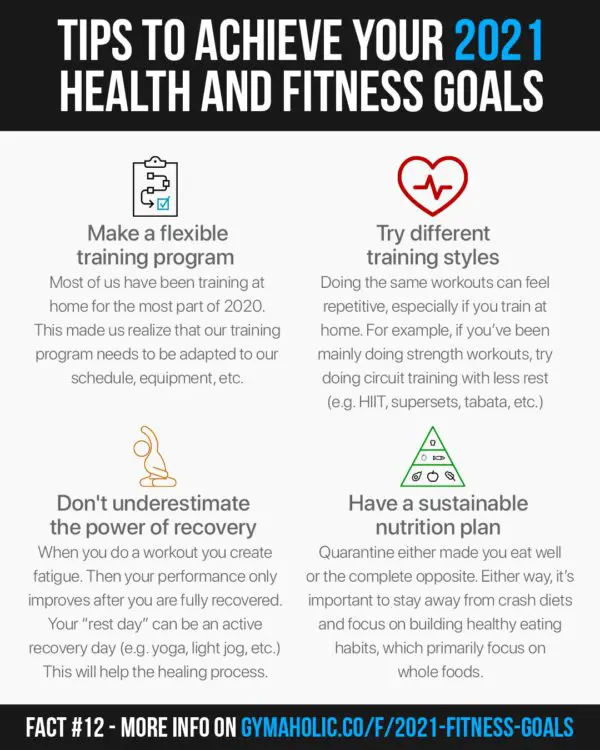
Most of us have been training at home for the most part of 2020.
This made us realize that our training program needs to be adapted to our schedule, equipment, etc.
Doing the same workouts can feel repetitive, especially if you train at home.
For example, if you’ve been mainly doing strength workouts, try doing circuit training with less rest (e.g. HIIT, supersets, tabata, etc.)
When you do a workout you create fatigue.
Then your performance only improves after you are fully recovered.
Your rest day can be an active recovery day (e.g. yoga, light jog, etc.)
This will help the healing process.
Quarantine either made you eat well or the complete opposite.
Either way, it’s important to stay away from crash diets and focus on building healthy eating habits, which focuses on whole food over processed food.
Frequently Asked Questions
To create a flexible training program for home workouts, consider your available equipment, time constraints, and fitness goals. Incorporate a mix of strength training, cardio, and flexibility exercises, and adjust the intensity and duration based on your schedule. For detailed guidance on home workouts, check out How To Work Out At Home.
To avoid workout monotony, try incorporating various training styles such as HIIT, circuit training, or supersets. These methods can add variety and challenge to your routine, keeping you engaged and motivated. For more on different training styles, read The Ultimate Progress Guide.
Recovery is crucial because it allows your muscles to repair and grow stronger after workouts. Without adequate rest, you risk injury and hinder your progress. Incorporate rest days and consider active recovery activities like yoga or light jogging to enhance recovery.
To maintain a sustainable nutrition plan, focus on building healthy eating habits that prioritize whole foods over processed ones. Avoid crash diets and instead aim for balanced meals that provide the necessary nutrients for your fitness goals. For more tips, see What Healthy Foods You Should Have On Your Plate.
To achieve your New Year’s fitness goals, set realistic and specific objectives, create a flexible workout plan, experiment with different training styles, prioritize recovery, and maintain a balanced nutrition plan. Consistency and adaptability are key to long-term success.
Tracking your fitness progress can be done through regular assessments of your strength, endurance, and body composition. Use fitness apps like the Gymaholic App to log workouts, track progress, and stay motivated with personalized plans.